Tag: project-management

  • UNICEF SVERIGE

    At Unicef 🇺🇳

    In the Agile and Methodology module, our client, UNICEF Sweden, engaged us in a design sprint to complete a project within one week. As the Scrum Master, I was responsible for enhancing the efficiency of our team, which consisted of four members, including a project manager and a developer. By utilizing Agile practices and facilitating effective collaboration, we successfully delivered the project on time and met all client expectations.

    Client’s Brief 🧶

    UNICEF Sweden approached us with a problem statement focusing on three main issues:

    1. Identifying a new target group.
    2. Developing a go-to-market strategy, including activities.
    3. Creating a digital concept.

    From this, we formulated our design questions to guide the project.

    Question of Design

    How Can We Digitally Engage and Connect With New Target Audiences? “

    Solution 💡

    Solution 1: BE THEIR HERO – Make a Difference With Every Step

    The marathon campaign serves as an inclusive platform uniting two key stakeholders: runners and donors. Runners participate to support their target group objectives through donation campaigns, while donors have the opportunity to support and contribute to these runner campaigns.
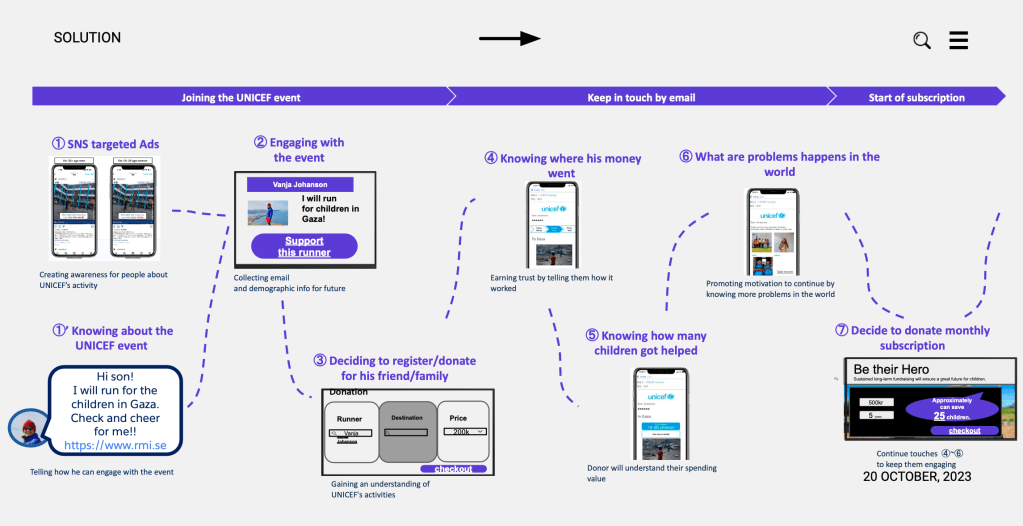
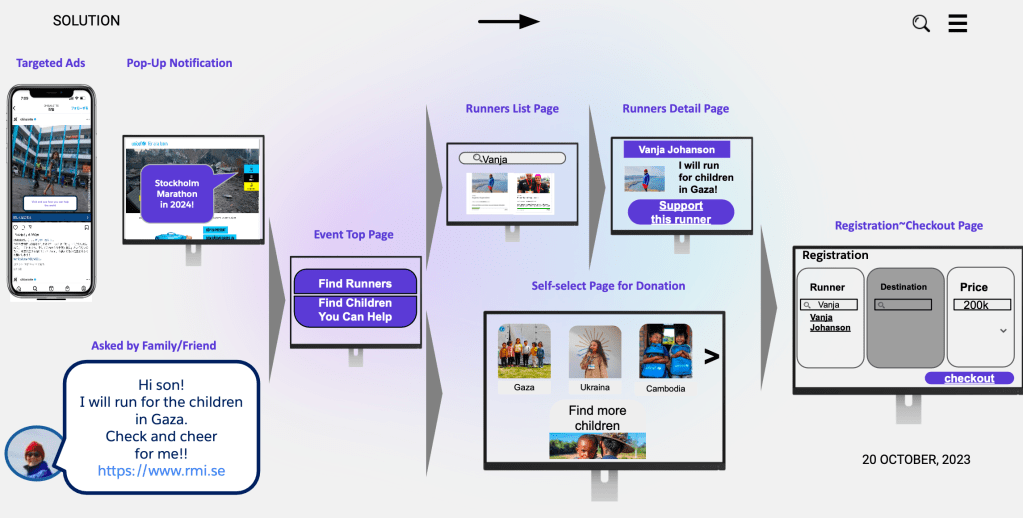
    Solution 2: Platform Prototype

    In our prototype solution, we’ve segmented the concept into a three-phase journey:

    1. Joining Event: Users seamlessly register for the event, ensuring a smooth onboarding process.
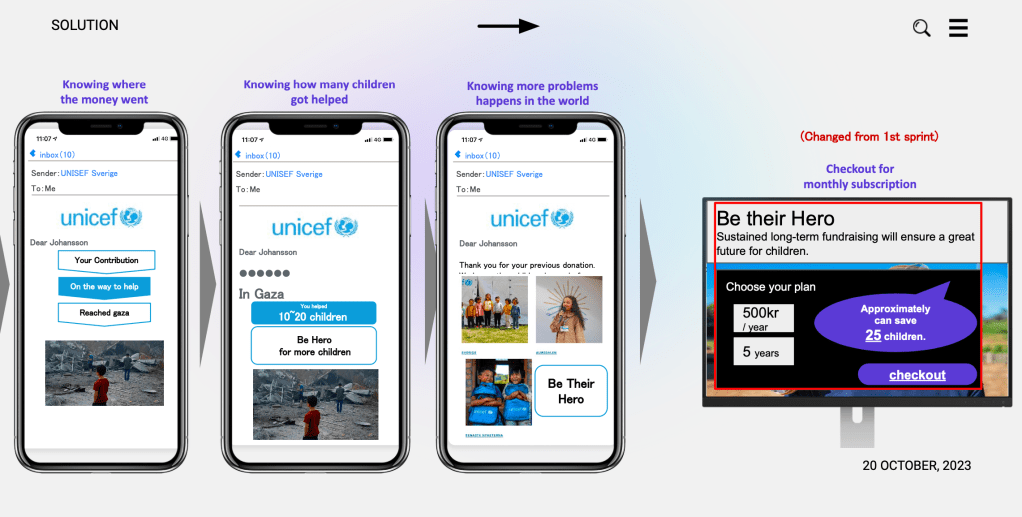
    2. Keep in Touch by Email: Subscribers receive regular email updates, maintaining engagement and fostering a sense of community.
    3. Start Subscription: We provide an option for users to subscribe, enhancing their involvement beyond the event.

    Additionally, we’ve implemented event tracking for donations, enabling donors to see the impact of their contributions and fostering a deeper connection with the cause.
    Process 🕹️

    Given the one-week timeframe for this project, we structured it into a project sprint. This included breaking down the tasks on a daily basis, defining specific events for each day, and clearly outlining the responsibilities of each team member and stakeholder involved in the project.
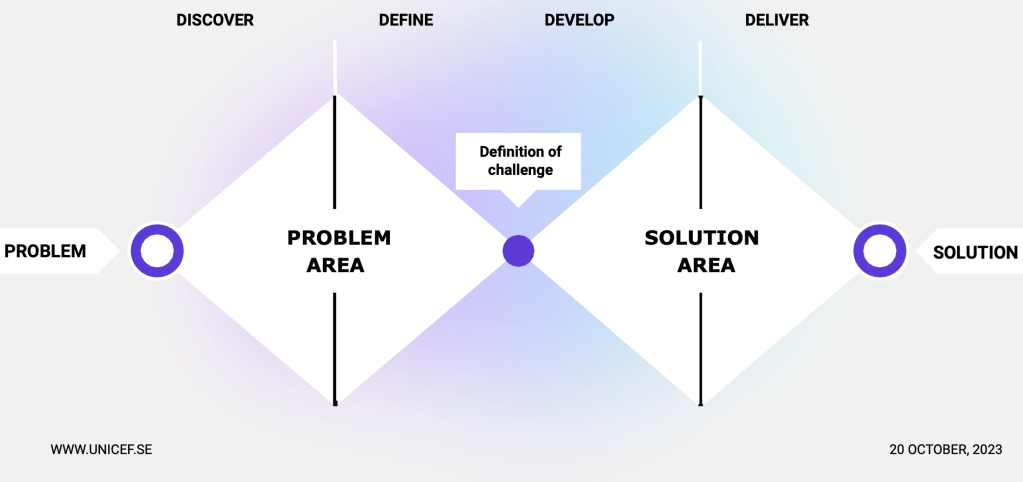
    We employed the Double Diamond design methodology to provide a comprehensive overview of the project, integrating it with Agile sprint methodology for effective execution.

    Our Approach:

    • Defined Roles: Assigned roles including Scrum Master (SM), Project Manager (PM), and development team members.
    • Product Backlog: Created and tracked the product backlog using Kanban.
    • Agile Events: Conducted essential Agile events such as Planning, Demo, and Retrospective in each sprint.
    • Knowledge Log: Documented the process in a knowledge log to maintain a product-focused mindset and ensure continuity and clarity.

    Sprint 1: We defined the target audience and campaign strategy, focusing on initiatives such as the UNICEF Marathon, email marketing, and long-term donor engagement. This framework guided us into the next steps.
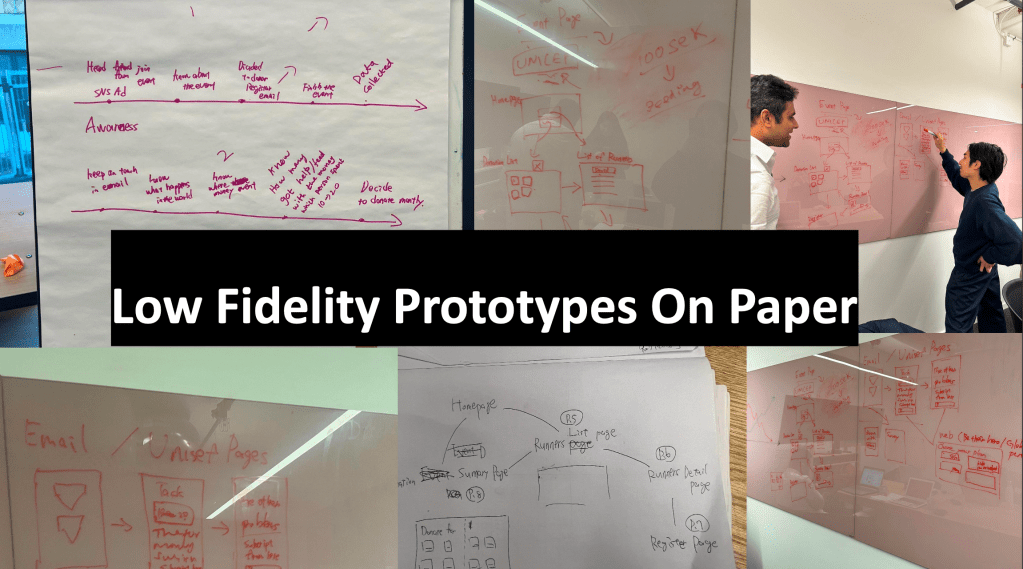
    Sprint 2: We developed the campaign titled “BE THEIR HERO – Make a Difference With Every Step.” During this sprint, we refined the key components identified in the first sprint and established a comprehensive marketing campaign. To ensure a long-term approach, we also developed a platform prototype for the UNICEF Marathon event. This prototype aims to enhance connectivity and engagement among participants and foster long-term relationships between runners and donors.

    What I learned 🤓

    I learned the importance of collaboration and transparency in project management. By assembling a diverse interdisciplinary team and prioritizing open communication, we were able to adapt and meet our goals efficiently in tight deadlines. While ensuring our software met functional requirements, I also realized the significance of comprehensive documentation. Utilizing tools like Notion for process logging and Kanban for backlog management ensured clarity and organization within our team. Embracing an incremental development approach allowed us to anticipate and mitigate risks early on. Regular validations with the client further enhanced our ability to address potential issues proactively. Despite the challenge of condensing our work into two sprints over five days, as opposed to the typical one to four-week timeframe, we remained agile and achieved successful outcomes. This experience reinforced the importance of flexibility and resilience in project execution.

  • Communication and Engagement Tools

    The idea

    Communication and Engagement Tools are methods and platforms used to facilitate effective communication, collaboration, and active participation among stakeholders, teams, and users. These tools are essential for ensuring that everyone involved in a project is informed, aligned, and engaged throughout its lifecycle.


    The process

    Types of Communication and Engagement Tools:

    1. Internal Communication Tools:
      • These tools help teams within an organization communicate and collaborate effectively. They support real-time messaging, file sharing, and project management.
      • Examples: Slack, Microsoft Teams, Trello, Asana.
    2. External Communication Tools:
      • These tools are used to communicate with external stakeholders, such as customers, clients, and partners. They facilitate customer support, marketing, and outreach efforts.
      • Examples: Email marketing platforms (e.g., Mailchimp), customer relationship management (CRM) systems (e.g., Salesforce), social media platforms.
    3. Engagement and Feedback Tools:
      • These tools gather input from stakeholders or users to ensure their needs and opinions are considered in decision-making processes. They can also be used to measure user satisfaction and engagement levels.
      • Examples: Surveys (e.g., SurveyMonkey), polls, feedback forms, and online communities.
    4. Collaborative Tools:
      • These tools enable multiple users to work together on documents, presentations, or projects in real-time, fostering teamwork and co-creation.
      • Examples: Google Workspace (Docs, Sheets, Slides), Miro, Figma.
    5. Video Conferencing and Webinars:
      • These tools facilitate virtual meetings, workshops, and presentations, allowing teams to communicate and engage remotely.
      • Examples: Zoom, Microsoft Teams, Google Meet, Webex.
    6. Social Media Engagement Tools:
      • These tools help manage and analyze social media interactions, enabling organizations to engage with their audience and build community.
      • Examples: Hootsuite, Buffer, Sprout Social.
    7. Content Management Systems (CMS):
      • These tools allow organizations to manage and distribute digital content, such as blogs, newsletters, and updates, to engage their audience.
      • Examples: WordPress, HubSpot, Drupal.
    8. Event Management Tools:
      • These tools are used to plan, promote, and manage events, helping organizations engage with their audience through live or virtual events.
      • Examples: Eventbrite, Meetup, Hopin.

    How to Use Communication and Engagement Tools:

    1. Identify Your Audience: Determine who you need to communicate with and engage, whether it’s internal teams, customers, or external partners.
    2. Choose the Right Tools: Select tools that are appropriate for your audience and objectives. For example, use Slack for team communication and Mailchimp for customer outreach.
    3. Plan Your Communication Strategy: Develop a clear plan for how and when you will communicate. This might include regular team meetings, customer newsletters, or social media updates.
    4. Engage Actively: Use the tools to facilitate active participation. Encourage feedback, questions, and collaboration to keep stakeholders engaged.
    5. Monitor and Adjust: Regularly review the effectiveness of your communication and engagement efforts. Adjust your strategy and tools as needed to improve outcomes.
    6. Ensure Consistency: Maintain consistent messaging across all communication channels to ensure clarity and coherence.
    7. Leverage Analytics: Use analytics provided by the tools to measure engagement levels, track communication effectiveness, and make data-driven improvements.

    References formatted in Harvard style:

    1. Slack Technologies. (n.d.) Slack. Available at: https://slack.com/ (Accessed: 4 August 2024).
    2. Microsoft Corporation. (n.d.) Microsoft Teams. Available at: https://www.microsoft.com/microsoft-teams/ (Accessed: 4 August 2024).
    3. Trello, Inc. (n.d.) Trello. Available at: https://trello.com/ (Accessed: 4 August 2024).
    4. Asana, Inc. (n.d.) Asana. Available at: https://asana.com/ (Accessed: 4 August 2024).
    5. Momentive Inc. (n.d.) SurveyMonkey. Available at: https://www.surveymonkey.com/ (Accessed: 4 August 2024).
    6. Google. (n.d.) Google Workspace. Available at: https://workspace.google.com/ (Accessed: 4 August 2024).
    7. Miro. (n.d.) Miro. Available at: https://miro.com/ (Accessed: 4 August 2024).
    8. Figma. (n.d.) Figma. Available at: https://www.figma.com/ (Accessed: 4 August 2024).
    9. Zoom Video Communications, Inc. (n.d.) Zoom. Available at: https://zoom.us/ (Accessed: 4 August 2024).
    10. Eventbrite. (n.d.) Eventbrite. Available at: https://www.eventbrite.com/ (Accessed: 4 August 2024).
    11. WordPress.org. (n.d.) WordPress. Available at: https://wordpress.org/ (Accessed: 4 August 2024).